
Necessary, Not Sufficient: Lobster Fishery Management for Business

We recently returned from an August lobster fishing trip to the Florida Keys with a smaller catch than in recent years. On the last day, we went scuba diving at Looe Key National Marine Sanctuary, and to my dismay, I didn't see any lobsters hiding in the reefs two years after my first visit. Subsequent research into the fewer numbers of lobsters encountered in the Keys this year led me to two conclusions:
The lesson here may be less about the lobsters and more about the conservation rule-makers: the fishery that adapted best was shaped by the people hauling the traps, with the state following their lead.
We must sustain the health of coral reefs, which support fisheries vital to up to one billion people and important ecotourism and recreation industries, as our planet continues to warm.
The State of the Corals
According to the recently released 2025 Global Coral Reef Monitoring Network report, the world's hard coral cover declined ~9.5% when comparing modern averages (2020 to 2024) relative to the reference period (1980 to 2009). The situation may actually be grimmer than the report, ending in 2024, suggests, because it excludes the full results of the worst global coral bleaching event, which lasted from 2023 to 2025, are known.
As an example, marine biologist Dr. Carlos Duarte highlighted the reefs in Western Australia that bleached for the first time in 2025, "recent 'major mortality' among Red Sea corals with little evidence of recovery, and reefs in the Caribbean that have lost about 90 percent of their genetic diversity."
The 2018 Southeast Data Assessment and Review (SEDAR) report revealed that only 10% of the original Caribbean coral coverage remains to generate habitat protection for juvenile spiny lobsters. While there is not yet conclusive evidence that this directly leads to a decline in spiny lobster stocks, there is a functional link between spiny lobster populations and the reef systems that provide them with food and shelter. (It is also likely that the 10% remaining coral coverage measurement in the Caribbean is lower after the 2023–2025 bleaching events.)
In the Florida Keys, a 30-year study by the Florida Fish and Wildlife Conservation Commission also found that juvenile lobster settlement dropped by roughly 30% since 1994. The researchers recommended that additional study is required to determine a correlation in adult stocks, since spiny lobster larvae are dispersed by prevailing ocean currents.
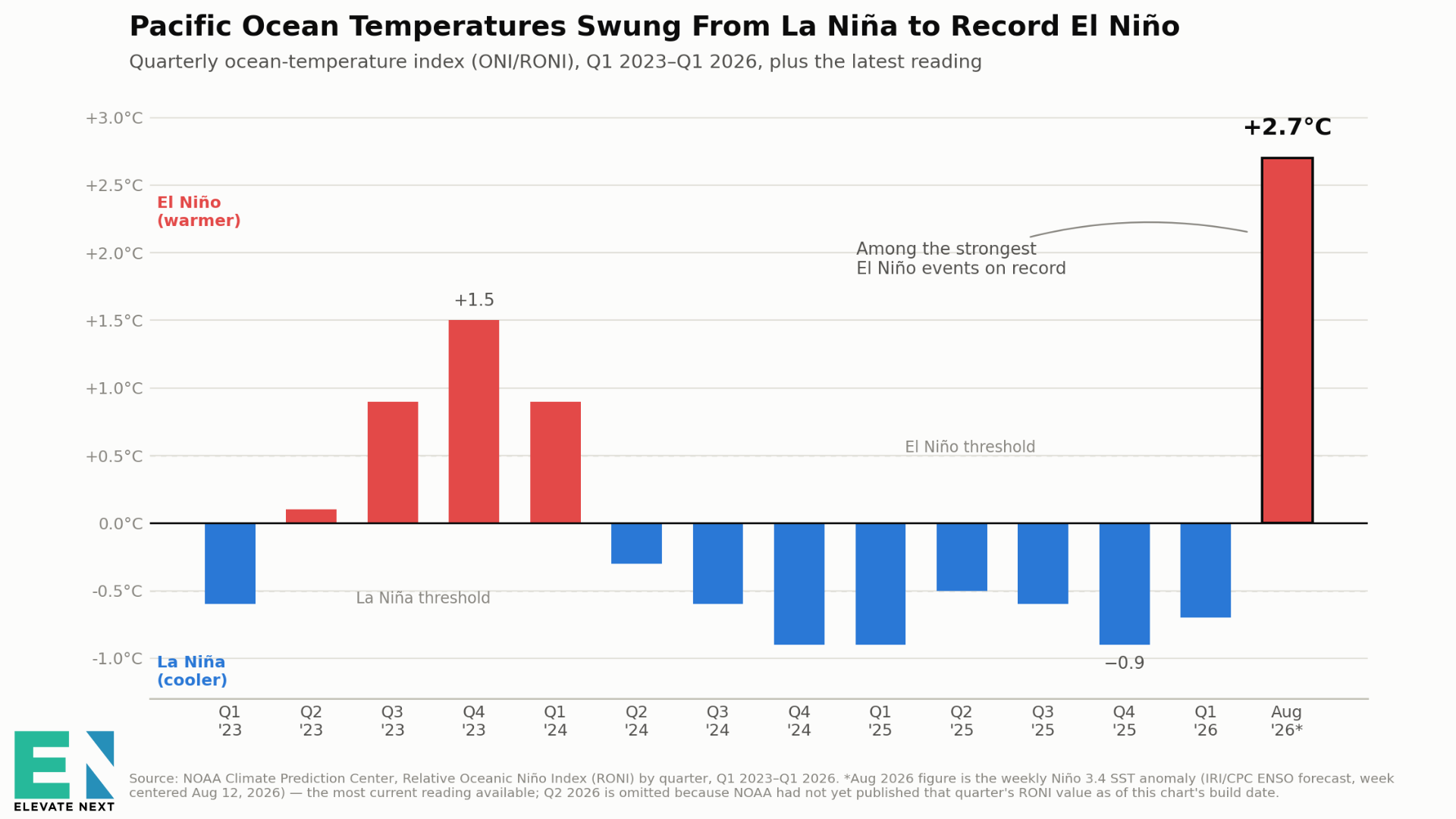
El Niño, a temperature anomaly in the Equatorial Pacific Ocean, is also currently forecasted to break all historical temperature records in the 2026-27 season. In late August, ocean surface temperatures in the tropical Pacific had already reached a record high of 85°F (29.4°C).
Lobster Fisheries in Maine and New England: Same Warming, Opposite Outcomes
Lobster harvesters in Maine self-imposed rules before the state required them: they notched the tails of pregnant lobsters to prevent them from being harvested again and sold, and they set limits on lobsters that are not only too small but also too big. In Florida, you have to throw back a pregnant lobster, but as long as there are no larvae and the lobster is of legal size (with a 3" carapace), you can have it for dinner. The Maine lobster industry's approach gives female lobsters more opportunities to breed and sustain the population.
Florida cut commercial trap limits from nearly 1 million to roughly half that by 1996 as part of a deliberate reduction program. It didn't reverse the trend: commercial landings still fell by half between the mid-1990s and mid-2000s.
Researchers determined that the lobster fishery in the Gulf of Maine grew by 515% over a thirty-year period (1984 to 2014), despite warmer water temperatures. Without the self-regulation, statistical models predicted a 242% growth. Southern New England's "lack of protections on larger reproductive lobsters," in contrast, "made the population less resilient to warmer waters" and resulted in a 78% decline during the same thirty-year period. Even with stricter conservation, models suggest the decline would still have reached 57%.
Researchers predict that the Northeastern U.S. lobster populations could continue to migrate north due to warming Atlantic temperatures. According to NOAA, American lobster, the species native to Maine and New England, reaches a "stress threshold" and experiences adverse health effects when water temperatures reach 68°F (20°C).
The Economic Stakes
The 2025 Global Coral Reef Monitoring Network report quantifies the significant benefits coral reefs provide us. Despite covering less than 0.2% of the ocean floor, coral reefs:
Provide a vital economic role, generating $9.9 trillion in ecosystem services and $36 billion in coral reef tourism and recreation;
Reduce up to 97% of wave energy, protecting 5.3 million coastal residents from an estimated $109 billion in storm damage and erosion;
Sustain more than 25% of marine species supported by coral reefs; and
Improve the livelihoods and food security of up to 1 billion people.
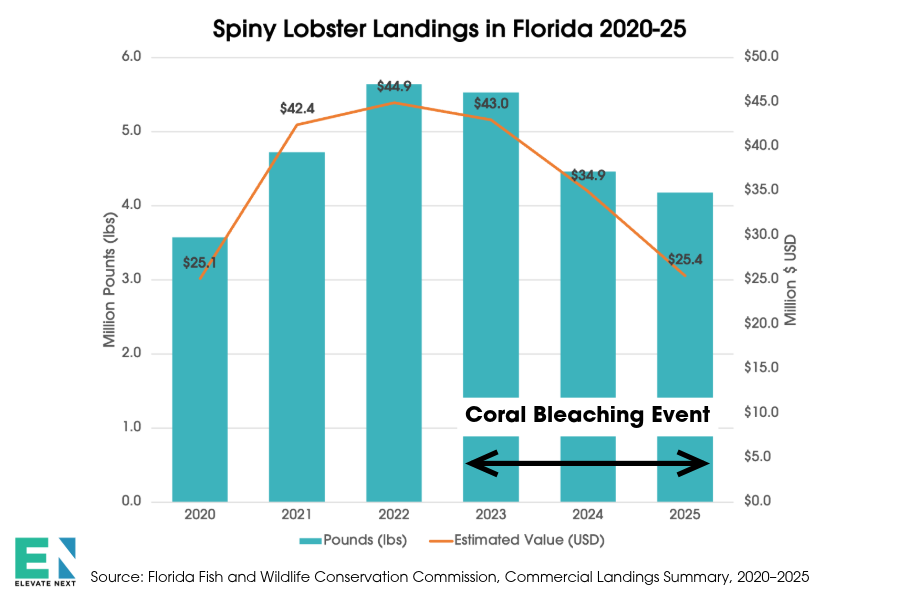
Florida's spiny lobster fishery is a direct beneficiary of that reef ecosystem. Statewide landings were worth an estimated $25.4 million in dockside value on 4.2 million pounds landed in 2025, down 43% in value and 26% in volume from a 2022 peak of $44.9 million and 5.6 million pounds, just before the worst global coral bleaching event on record (2023–2025).*
Regulation is Necessary, But Not Sufficient
The states of Maine and Florida both regulate their lobster fisheries to protect breeding stock: Maine through industry-led practices adopted ahead of state law, and Florida through a state-run trap-reduction program that nearly halved fishing effort. (Florida regulations also prevent harvesting of pregnant lobsters and juveniles with carapaces less than 3 inches.)
Only one fishery, in Maine, had environmental conditions on its side. Warming Atlantic waters pushed the Gulf of Maine's American lobster species into the cold-water species' biological sweet spot.
In contrast, Florida's Caribbean spiny lobster is a different warm-water species whose optimal range peaks around 82°F (28°C), with thermal stress setting in near 86°F (30°C). Florida Keys waters are already close to that upper edge for much of the year, before any additional warming.
State regulation alone didn't determine success: it revealed how well each fishery could capitalize on good conditions or limit the damage from bad conditions.
What Does this Mean for Business?
What environmental and ethical standards are you holding your business to, regardless of whether the market is rewarding you for it yet? If you have an answer to that, are you telling that story to your publics, or just discreetly taking action?
In a public relations context, remaining silent is a significant opportunity cost: you could be generating goodwill, brand loyalty, and additional revenue by sharing your company’s proactive, ethical conservation efforts.
Related Articles



In an era defined by AI, shrinking attention spans, and digital noise, three lessons from journalism offer powerful guidance for modern professionals. From leveraging AI wisely to acknowledging bias and practicing intentional listening, these human skills are becoming more valuable—not less.